 MinutesKept
What Is an IEP? A Plain-Language Guide for Parents

Short answer: An IEP (Individualized Education Program) is a written plan for a child with a disability who qualifies for special education in a US public school. It lists your child's goals and the services the school will provide, including how often and how long, such as 30 minutes of speech therapy twice a week. The team, including you, reviews it at least once a year.
MinutesKept is a simple phone tool for parents of children with an IEP. Once a week, the parent answers one question per service, and MinutesKept shows the minutes promised, received and missing. Organize and document. Not legal advice.
If someone at school just said "IEP" and you nodded along, you're not alone. Most parents hear the word for the first time in a meeting full of people who already know it.
Here's what it means, what's inside it, and the one part most parents never get to check.
IEP meaning: what does IEP stand for?
IEP stands for Individualized Education Program. The federal special-education rules define it as "a written statement for each child with a disability" (34 CFR 300.320). It comes from the Individuals with Disabilities Education Act (IDEA).
In everyday words: it's your child's plan, in writing, for what the school will do.
Who qualifies for an IEP?
A child gets an IEP after an evaluation shows two things: the child has a disability covered by IDEA (for example a speech or language impairment, autism, ADHD under "other health impairment", or a learning disability), and the child needs special education to make progress in school.
You can ask the school for an evaluation in writing. If your child doesn't qualify for an IEP, a 504 plan may still give accommodations (more on that below).
What's in an IEP?
Every IEP has the same main parts:
- Present levels: where your child is today, in school and in daily skills.
- Annual goals: what your child should be able to do by the next review.
- Services: special education and related services, like speech therapy, occupational therapy (OT), physical therapy (PT), counseling or reading support.
- Accommodations: changes like extra time, a quiet room or tests read aloud.
- How progress is reported to you.
The services part is the one to read slowly. The rules say the IEP must give "the anticipated frequency, location, and duration" of each service (34 CFR 300.320). That's where you see lines like "Speech-language therapy, 30 minutes, 2 times per week." These are your child's service minutes.
Who writes the IEP, and how often does it change?
The IEP is written by a team: you, your child's teachers, a special-education teacher, a school district representative and others who know your child (34 CFR 300.321). You're a full member of that team, and your concerns must be considered (34 CFR 300.324).
- The team reviews the IEP at least once a year.
- Your child is reevaluated at least every 3 years, unless you and the school agree it isn't needed (34 CFR 300.303).
- You can ask for an IEP meeting sooner if something isn't working.
IEP vs 504 plan: what's the difference?
| IEP | 504 plan | |
|---|---|---|
| Law | IDEA (special education) | Section 504 (civil rights) |
| For | A disability that requires special education | A disability that substantially limits a major life activity |
| Gives | Goals, services and accommodations | Mainly accommodations |
| Written plan | Yes, with set parts | Usually, but the format varies |
What part of the IEP do most parents never check?
Once the IEP is in effect, services must be provided "in accordance with the child's IEP" (34 CFR 300.323).
But sessions can be missed for ordinary reasons: a therapist is out, a schedule changes, a field trip takes the slot. Your child may not mention it. Months later, at the annual review, it's your memory against the school's schedule.
The simplest fix is a short weekly record: did each service happen this week, all of it, some or none?
Where MinutesKept fits
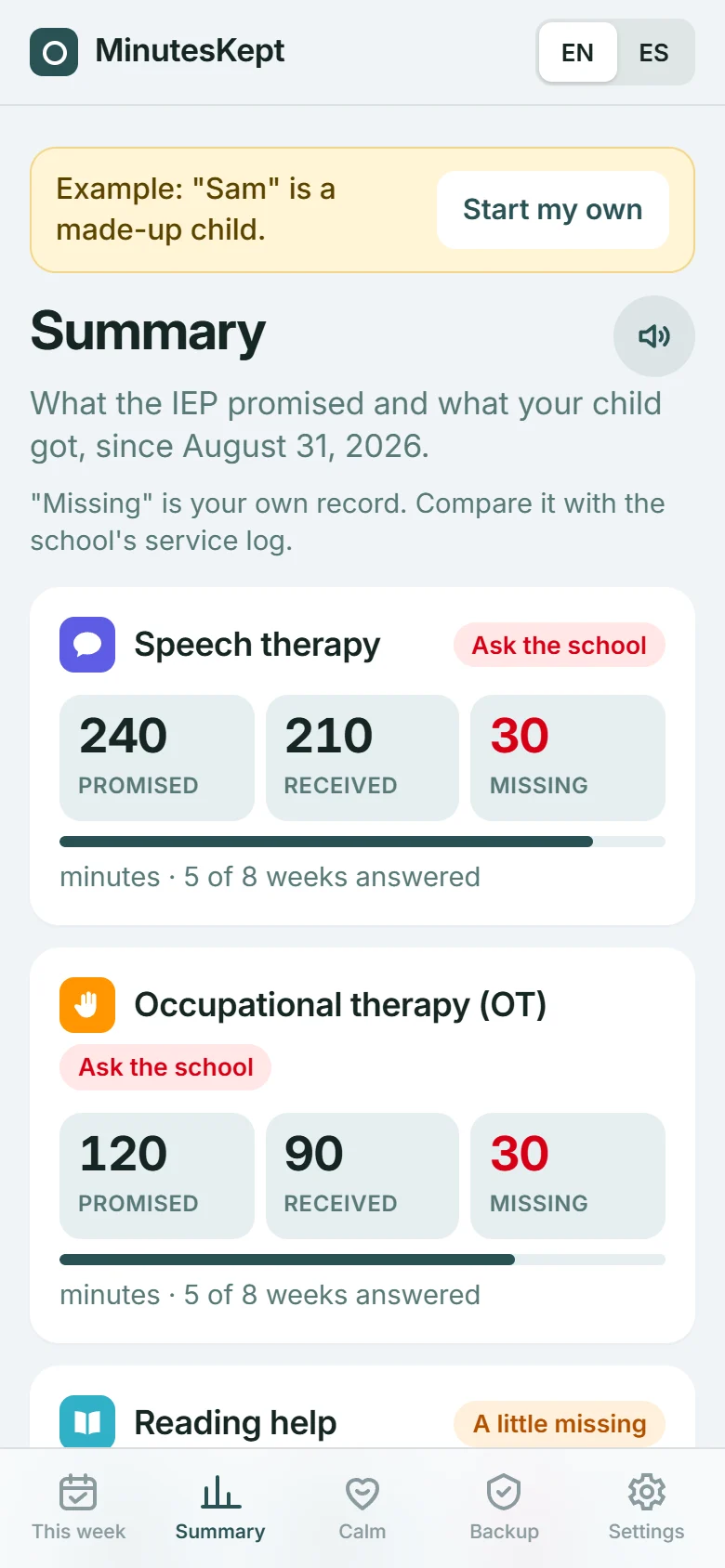
MinutesKept is a simple phone tool for that weekly record.
- Once, about 2 minutes: tap in each service and its minutes, as the IEP lists them.
- Every week, about 10 seconds: one question per service. Tap it, say it or type it, in English or Spanish.
- Automatic: minutes promised, received and missing, week by week, with dates.
- Before the meeting: one page to print or show on your phone, and a ready email asking the school for its service log.
It never asks for your child's name, and you don't upload the IEP. Your record stays on your phone.
Not an IEP family? It also works for a 504 plan with services, early intervention (IFSP), private speech or OT, or tutoring: if sessions are promised each week or month, you can track them under your own service name.
Try the free example (made-up child "Sam") →
Questions parents ask
What does IEP stand for?
Individualized Education Program: a written plan for a child with a disability who qualifies for special education in a US public school.
What are IEP service minutes?
The time the IEP says your child will receive each service, for example 30 minutes of speech therapy twice a week.
How often is an IEP reviewed?
At least once a year. You can also ask for a meeting sooner.
What's the difference between an IEP and a 504 plan?
An IEP comes from special-education law (IDEA) and includes goals and services; a 504 plan comes from civil-rights law and mainly gives accommodations.
Can I see whether my child's services actually happen?
You can ask the school for its service log, and keep your own weekly record to compare.
Organize and document. Not legal advice. For free help with your rights, contact your state's Parent Training and Information Center.