 MinutesKept
IEP Minutes Not Being Met: What to Do, in Order

Short answer: Write down what was missed, week by week, and ask the school for its service record. Then ask in writing for an IEP team meeting to talk about the gap and a plan to make the minutes up. If that goes nowhere, federal rules let you file a state complaint, and the clock on that is one year. Whether a gap counts as a violation depends on how many sessions were missed and what it did to your child's progress.
MinutesKept is a simple phone tool for parents of children with an IEP. Once a week, the parent answers one question per service, and MinutesKept shows the minutes promised, received and missing. Organize and document. Not legal advice.
You read the IEP: speech, 30 minutes, twice a week. Then you notice your child hasn't mentioned a speech session in a while. Or the therapist's name changed in October and nobody told you. Or the progress report says "continuing," and you can't tell what that means.
It's an uneasy place to be, and most parents sit there for months because they don't have a number. Here is the order that works, starting with the cheapest step.
How do I know if my child's IEP minutes are not being met?
Count them. Your feeling isn't evidence, but a dated record is. For each service in the IEP, write down the minutes promised per week and the minutes your child actually received, week by week, and the reason for any miss if you know it. A weekly note of about ten seconds is enough. Here is how to count missed IEP minutes once you have a few weeks written down.
Don't wait for certainty before you ask questions. A school can only tell you the real number if someone asks.
Is every missed session a violation?
No, and it helps to know that before your first email. Wisconsin's Department of Public Instruction, in its guidance on interruptions in IEP services, says that a provider's absence on one day, with the session made up on another day, "is not likely a denial of FAPE." FAPE is "free appropriate public education," the thing the IEP exists to deliver.
The same guidance says whether missed services amount to a denial of FAPE "must be made on a case-by-case basis." The school is to look at two things: "the number of missed sessions or minutes compared to the amount required by the IEP," and "the effect on student progress." When the missed amount is substantive, the sessions aren't made up, and the child isn't making adequate progress on the goals those services target, the guidance says the requirement to implement the IEP as written "has not been met."
That is one state's guidance, written for its districts, and your state's rules may differ. It is still a clear description of what a team will weigh: how much, whether it was made up, and whether your child is moving.
What should I ask the school for first?
Two things, in one email: the provider's record of sessions, and a meeting.
The record shows which sessions took place, the minutes, and why any session didn't. How to ask for an IEP service log has a copy-and-paste request under 34 CFR 300.613.
For the meeting, 34 CFR 300.324(b) says the IEP team reviews the IEP at least once a year and revises it, "as appropriate," to address any lack of expected progress toward the annual goals. The rule says "as appropriate," not "on request," so the meeting is something you ask for rather than something the rule hands you on demand. A short, specific email works:
Subject: Request for IEP team meeting: [child's initials], [speech-language] services
Hello [name],
My records show that [child's initials] received about [X] of the [Y] minutes of [speech-language] therapy the IEP provides between [start date] and [end date]. I'd like to meet with the IEP team to go over the dates, understand the reasons, and agree on a plan to make up the missed minutes.
Could you suggest two or three times in the next two weeks? If you have the provider's session log, please bring it.
Thank you,
[your name]
Say the dates and the numbers, and leave out blame. A team can answer "here are the weeks I have, do yours match?" in a way it can't answer "you're ignoring the IEP."
What if the school says no, or says nothing?
Ask for the answer in writing. Under 34 CFR 300.503, the school must give you written notice a reasonable time before it proposes or refuses to change "the provision of FAPE to the child." That notice has to describe what it refused and explain why. A refusal that comes with a written reason is easier to act on than a hallway conversation.
If weeks pass with no reply, send a short follow-up with the date of your first email. The date is the point.
When can I file a state complaint?
Every state has a complaint process for IDEA violations. Under 34 CFR 300.153, you send the state education agency a signed written complaint that says the school violated the law, gives the facts, includes your contact information and your child's name, address and school, and proposes a resolution if you have one. You also send a copy to the school at the same time.
Three details matter for timing and outcome:
| Detail | What the rule says |
|---|---|
| How far back it can reach | The violation must have happened "not more than one year" before the complaint is received (300.153) |
| How fast the state must act | A time limit of 60 days after the complaint is filed to investigate and issue a written decision; it can be extended only in exceptional circumstances or if both sides agree to mediation (300.152) |
| What the state can order | If it finds a failure to provide appropriate services, it must address that failure, including "compensatory services or monetary reimbursement" (300.151) |
The one-year window is the reason to start counting early. Minutes missed in September can drop out of reach next September, while a record you wrote at the time still shows them.
A due process complaint is a different and more formal route. The federal rule gives two years from when you knew or should have known about the problem, or the state's own time limit if it has one (34 CFR 300.507). Your state's Parent Training and Information Center can explain both routes for free.
What should I keep while this happens?
- Your weekly record, with the dates you wrote each entry
- Every email you sent and received about the services
- The school's service log, once you have it
- Progress reports, so you can see what changed on the goals tied to the missed service
- Notes from meetings, with the date and who attended
Nobody is asking you to build a case. A tidy folder makes a calm conversation possible, and it makes a harder one shorter if it comes to that.
Where MinutesKept fits
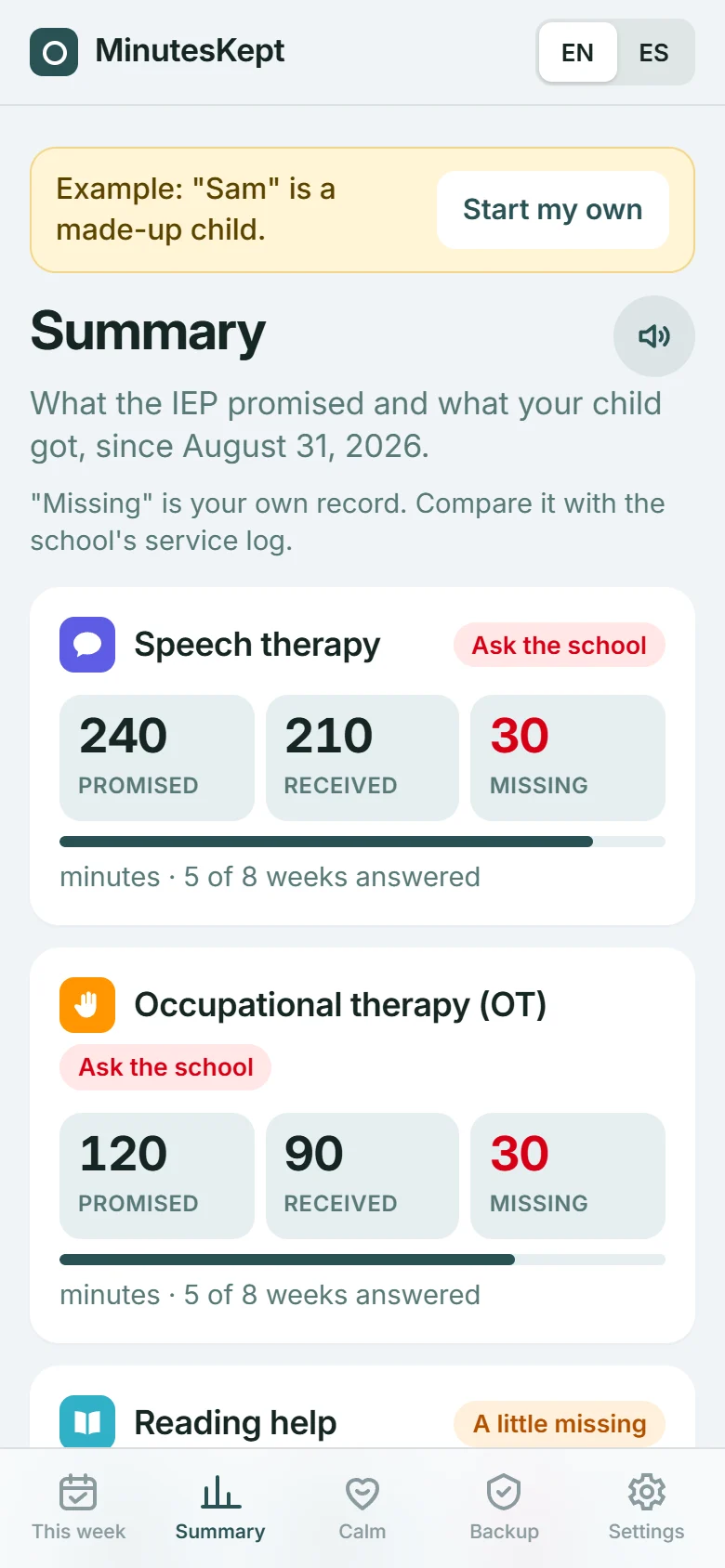
MinutesKept is a phone tool for the weekly record. It does not store your IEP or any document.
- Once, about 2 minutes: add each service from the IEP with its minutes, such as speech 30 minutes, 2 times a week.
- Every week, about 10 seconds: one question per service. Tap "Yes, all of it", "Only some", "No, not at all" or "No school this week". Pick a reason for a miss, like "Therapist was absent". English or Spanish.
- Automatic: minutes promised, received and missing, week by week, with dates.
- When something's off: a ready email asking the school for its service log, and one page to bring to the meeting.
It never asks for your child's name, and your record stays on your phone.
Not an IEP family? The same weekly record works for a 504 plan with services, early intervention (IFSP), private therapy or tutoring. If a provider is delivering fewer sessions than you agreed to, the dated list is what lets you ask about it.
See how it looks before you add anything of your own. Free, no sign-up, opens on any phone.
Try the free example (made-up child "Sam") →
Also worth reading: a free email template to ask for make-up IEP sessions, 5 signs your child is missing IEP minutes, and what to do when the school isn't following the IEP.
Questions parents ask
What can I do if my child's IEP minutes are not being met?
Record the missed sessions by week, ask the school for the provider's service record, and request an IEP team meeting in writing to discuss the gap and a plan to make the minutes up. If that fails, you can file a state complaint with your state education agency.
Is a missed therapy session a violation of the IEP?
Not automatically. Wisconsin's guidance says a provider's one-day absence that is made up on another day is not likely a denial of FAPE. A violation depends on how many sessions were missed, whether they were made up, and the effect on your child's progress.
How long do I have to file a state complaint about missed IEP services?
Under 34 CFR 300.153, the violation must have occurred not more than one year before the state receives your complaint. The state then has a 60-day time limit to investigate and issue a written decision, which can be extended only in limited cases (34 CFR 300.152).
Can the school be made to give the missed minutes back?
If a state finds the school failed to provide appropriate services, federal rules require it to address that failure, including through compensatory services or reimbursement (34 CFR 300.151). Compensatory services aren't necessarily minute for minute; Wisconsin's guidance says the team decides what the child needs to make up for missed learning.
Should I ask for an IEP meeting or file a complaint first?
Most families start with a written request for a meeting, because it is quick and keeps the conversation open. The complaint is there if the school won't engage. Watch the one-year window while you wait.
Does this apply if my child has a 504 plan or private therapy?
The IEP rules above are for IEPs. For a 504 plan, early intervention, private therapy or tutoring, the same weekly record helps you ask the provider or school about missed sessions. The complaint routes differ, so ask your state's Parent Training and Information Center.
Organize and document. Not legal advice. For free help with your rights, contact your state's Parent Training and Information Center.
Sources, opened November 9, 2026: Wisconsin DPI, "Considerations for Interruptions in IEP Service Delivery" (undated); 34 CFR 300.324; 34 CFR 300.503; 34 CFR 300.151; 34 CFR 300.152; 34 CFR 300.153; 34 CFR 300.507.