 MinutesKept
How to Count Missed IEP Minutes (and What to Do With the Number)

Short answer: Missed IEP minutes are the minutes your child's IEP promises minus the minutes they actually received. Multiply the IEP's minutes per week by the number of school weeks, subtract the sessions that happened, and write down each miss with its date and reason. That number is what the school team asks about first.
MinutesKept is a simple phone tool for parents of children with an IEP. Once a week, the parent answers one question per service, and MinutesKept shows the minutes promised, received and missing. Organize and document. Not legal advice.
You suspect the speech sessions have been thin since October. Your child comes home and says "we didn't go today" about as often as "we went," and you can't say which one you heard more. The school says services are on track. You'd like to believe it.
Believing and knowing are different things, and only a count tells you which one you're doing. Here's how to build one.
What counts as a missed IEP minute?
A minute is missed when the IEP says a service happens and it doesn't. Wisconsin's education department puts it plainly: an interruption happens "whenever an IEP service is not provided according to the frequency, amount, or duration documented in the student's IEP." That covers a therapist who was out sick, a shortage of staff, a school closing, a schedule change, a session that ran 15 minutes instead of 30.
The reason doesn't change the count. Disability Rights Ohio, an advocacy group, says it directly: "It does not matter why the minutes were not provided." It adds that even when a teacher is out sick or the school is closed, the minutes still must be provided.
Counting is not the same as proving a violation. Wisconsin's guidance says a few missed sessions that get made up are not likely a denial of a free appropriate public education (FAPE), and that the question is decided case by case. So the number is where the conversation starts, not where it ends.
How do I count missed IEP minutes, step by step?
- Find the service line. Open the IEP and look for the services page. It lists the service, minutes per session, how often, and where. Example: speech-language, 30 minutes, 2 times a week.
- Work out the minutes promised. Minutes per session × sessions per week × school weeks in the period. 30 × 2 × 10 weeks = 600 minutes.
- Write down what happened. For each week, how many sessions took place, and for each miss, the date and the reason if you know it.
- Subtract. Promised minus delivered is the number missed.
- Keep short sessions in the count. If a 30-minute session lasted 15, that's 15 minutes missed, not zero.
Here is a made-up child, "Sam," over ten school weeks:
| Sessions | Minutes | |
|---|---|---|
| Promised (2 a week × 10 weeks × 30 min) | 20 | 600 |
| Delivered | 16 | 480 |
| Missed | 4 | 120 |
Sam's four misses: therapist out (two sessions), a school assembly, testing week. Four lines with dates is a short list. Rebuilt from memory in May, it's an argument.
How do I get the school's service logs?
Ask in writing. Email is fine, and it gives you a date stamp. Say which service and which dates you're asking about, and ask for the provider's log of sessions delivered and sessions missed.
Wisconsin's guidance encourages districts to have providers keep exactly this kind of record, and says any deviation from the IEP "should include the date and reason for interruption in service delivery." Whether your district does that varies, so ask and see what comes back.
Then compare their log with yours. If the two agree, you have a clean number. If they don't, you have a specific question for the team: "My record shows 4 missed sessions between October 1 and December 15. Yours shows 1. Can we go through the dates?"
What are compensatory services?
Compensatory services are extra services a child receives to make up for services the school should have provided. Wisconsin's guidance describes them as intended "to make up for the FAPE violation," and notes they are "not necessarily provided minute-for-minute." The IEP team decides what the child needs to make up for what was missed.
Disability Rights Ohio suggests a practical starting point: work out how many minutes were actually missed and "use that as a baseline for negotiation." You request it from the IEP team by email or letter, and the team should meet to discuss the amount and type.
Real outcomes vary, and these are not promises about yours. In one Connecticut state complaint (case 26-0605, findings sent June 8, 2026), the district had not delivered 690 minutes of group language services. The district kept a log of the missed services. The parent and district agreed on a 300-minute compensatory plan, and the state recorded 120 minutes still to be delivered by September 15, 2026. Every case turns on its own facts.
When do missed IEP minutes have to be made up?
There isn't one federal rule that answers this. Wisconsin's guidance notes that neither the federal law (IDEA) nor its state law specifically addresses missed IEP services. What the federal rules do say is that services must be made available "in accordance with the child's IEP" (34 CFR 300.323). Whether a gap becomes a compensatory services question depends on how many minutes were missed against the IEP and what happened to your child's progress.
Practically: the sooner you notice, the easier it is to ask for make-up sessions while they can still be scheduled. A weekly record catches a miss in week 3, when it's a scheduling question, not in week 30.
Where MinutesKept fits
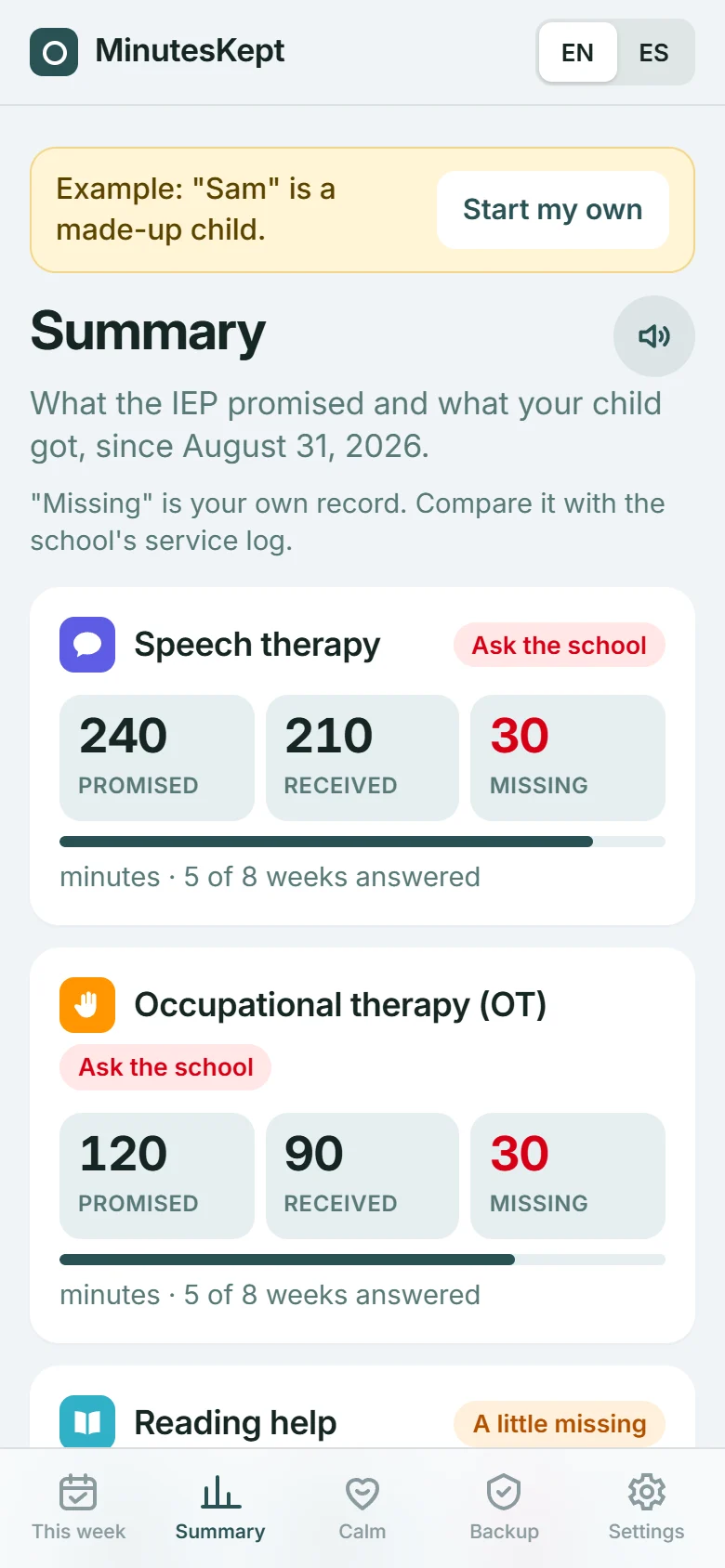
MinutesKept is a phone tool for that weekly record, and the arithmetic above is what it does for you.
- Once, about 2 minutes: add each service from the IEP with its minutes, like speech 30 minutes, 2 times a week.
- Every week, about 10 seconds: one question per service. Tap "Yes, all of it", "Only some", "No, not at all" or "No school this week". Pick a reason for a miss, like "Therapist was absent". English or Spanish.
- Automatic: minutes promised, received and missing, week by week, with dates.
- When something's off: a ready email asking the school for its service log, and one page to bring to the meeting.
It never asks for your child's name, and you don't upload the IEP. Your record stays on your phone.
Not an IEP family? Counting works the same for a 504 plan with services, early intervention (IFSP), private therapy or tutoring. If sessions are promised each week or month, you can track them.
See how it looks before you add anything of your own. Free, no sign-up, opens on any phone.
Try the free example (made-up child "Sam") →
Also worth reading: 5 signs your child is missing IEP minutes, what to do when the IEP isn't being followed, and the IEP minutes record test.
Questions parents ask
What are missed IEP minutes?
They are the minutes of a service the IEP promised that your child did not receive. Add up the minutes promised for a period, subtract the minutes delivered, and the difference is the number missed. The reason for the miss does not change the count.
Is every missed IEP session owed back?
Not automatically. Wisconsin's education department says minor interruptions that get made up are not likely a denial of FAPE, and larger gaps are judged case by case, by comparing minutes missed to the IEP and looking at the effect on progress.
Who keeps the record of IEP services?
The school provider may keep a service log, and you can ask for it in writing. You can also keep your own weekly record. When the two match, the team can move on to what to do next.
What are compensatory services in special education?
Extra services given to make up for services the school should have provided. They are decided by the IEP team and are not necessarily minute-for-minute.
Can I count minutes if my child doesn't have an IEP?
Yes. The same count works for a 504 plan with services, early intervention, private therapy or tutoring, anywhere sessions are promised on a schedule.
How do I ask the school for make-up sessions?
Email the IEP team, name the service and dates, give your count, and ask to meet to discuss make-up services. Keep the email: it carries the date.
Organize and document. Not legal advice. For free help with your rights, contact your state's Parent Training and Information Center.
Sources, opened November 2, 2026: Disability Rights Ohio, "Understanding Compensatory Education" (June 29, 2021); Wisconsin DPI, "Considerations for Interruptions in IEP Service Delivery"; Connecticut State Department of Education, complaint 26-0605; 34 CFR 300.323.