 MinutesKept
Compensatory Education for Missed IEP Services: How to Ask (Email Template)

Short answer: Compensatory education, also called compensatory services, is extra help a school gives to make up for IEP services it didn't deliver. To ask for it, email your child's IEP team: name the service, give your count of missed sessions with dates, request the provider's log, and ask the team to meet and decide the make-up plan. A copy-and-paste email is below.
MinutesKept is a simple phone tool for parents of children with an IEP. Once a week, the parent answers one question per service, and MinutesKept shows the minutes promised, received and missing. Organize and document. Not legal advice.
Maybe you've counted. Speech was supposed to happen twice a week since September, and your list has eleven sessions that didn't. Now what do you write, and to whom, without sounding like you're picking a fight?
Short and factual wins. A calm email with dates is hard to argue with and easy to answer. Here is what to gather, what to say, and a letter you can copy.
What is compensatory education for missed IEP services?
It is extra service meant to make up for service the school should have provided. Disability Rights Ohio, an advocacy group, says the aim is "to put the student in the position the student would be in" had the services been delivered. Wisconsin's education department describes compensatory services as intended "to make up for the FAPE violation," and adds that they are "not necessarily provided minute-for-minute." (FAPE is the "free appropriate public education" the IEP exists to deliver.)
Two things follow from that. The IEP team decides the amount and kind, so you're asking for a meeting and a plan, not a fixed number. And the reason for the miss doesn't change your right to ask: Disability Rights Ohio says "It does not matter why the minutes were not provided."
When should I ask for compensatory services?
As soon as you have a count that worries you. Don't wait for the end of the year.
Not every missed session becomes a compensatory services question. Wisconsin's guidance says the team looks at how much was missed and whether it affected your child's progress toward IEP goals, case by case. A session missed and promptly rescheduled is a different situation from six weeks of nothing. Your weekly record shows which one you're in.
Two deadlines are worth knowing about, because they're a reason to ask early. Under the federal rules, a state complaint must allege a violation that happened no more than one year before the state receives it (34 CFR 300.153). A due process hearing request generally must be made within two years of when you knew or should have known about the problem, unless your state sets its own limit (34 CFR 300.511). Your state's rules may differ, so check yours.
What do I need before I write?
Four things, none of them hard:
- The service line from the IEP. Service, minutes per session, how often. Example: speech-language, 30 minutes, 2 times a week.
- Your dates. From and to.
- Your count. Sessions promised, sessions that happened, sessions missed, with the date of each miss and the reason if you know it. Here is how to build the count.
- The name of the person you're writing to. The case manager or the special education coordinator, with the principal copied.
You do not need to prove anything yet. The email asks for the school's own record and a meeting.
What do I write? A copy-and-paste email template
Replace everything in [brackets]. Delete any line that doesn't fit. Send it from your own email so the date is stamped. Nothing you type here is sent to MinutesKept.
Subject: Request for make-up IEP services for [child's first name], [school name]
Dear [case manager / special education coordinator],
I'm writing about [child's first name]'s [service, for example speech-language therapy]. The IEP dated [IEP date] provides [minutes] minutes, [number] times a week.
From [start date] to [end date], I count [number] sessions that did not take place, about [total minutes] minutes. The dates I have are: [date and reason, if known; one per line].
Please send me the provider's log of sessions delivered and sessions missed for that period.
I'd like to request make-up services for the minutes that were missed, and I'm asking the IEP team to meet to decide the amount and type of compensatory services. Could you suggest two or three dates in the next two weeks?
Please reply in writing so we both have the dates on record.
Thank you,
[your name]
[your phone number]
[parent / guardian of child's first name]
A few notes on why it's built this way:
- It names the IEP and the dates. Vague emails get vague answers.
- It asks for the log in the same message. Federal rules give parents the right to inspect and review their child's education records, and the school must comply "without unnecessary delay and before any meeting regarding an IEP," and in no case more than 45 days after the request (34 CFR 300.613). Whether a particular provider log counts as a record is something to ask the school, which is why the request names it.
- It asks for a meeting, not a number. Wisconsin's guidance says decisions about compensatory services are made by the IEP team.
- It leaves out blame. You can add detail later. The first email's job is to get a dated reply.
Want the next guide by email?
The letter above is yours, no email needed. If you'd like the next guide when it comes out, leave your email. One message per guide, nothing else.
What happens after I send it?
Ideally, a reply with the log and a meeting date. At the meeting, bring your count. Disability Rights Ohio suggests working out how many minutes were actually missed and using that "as a baseline for negotiation." Compare your count with the school's log, line by line. If the two disagree, ask to go through the dates together.
Wisconsin's guidance describes what the team can do when the missed services affected progress: hold an IEP meeting, or, with the parent's agreement, write the compensatory services into the IEP, stating the duration, frequency and amount. If the team decides none are needed, the guidance says to document that agreement. Ask for the outcome in writing either way.
Real outcomes vary and nothing here promises one for your child. The email is a first step, and a written record is what makes the next step possible.
What if the school says no, or doesn't answer?
Write a short follow-up that quotes your first email and asks again for the log and the meeting. Keep it polite and dated.
If that doesn't move things, you have formal options. Disability Rights Ohio lists a complaint to your state education agency, a due process complaint with a hearing, and free mediation or facilitation. Under the federal rules, a state that finds a failure to provide appropriate services must address it, "including corrective action appropriate to address the needs of the child," which the regulation connects to compensatory services (34 CFR 300.151).
Before filing anything, talk to someone who does this for free. Every state has a Parent Training and Information Center that helps families with IEP disputes at no charge.
Where MinutesKept fits
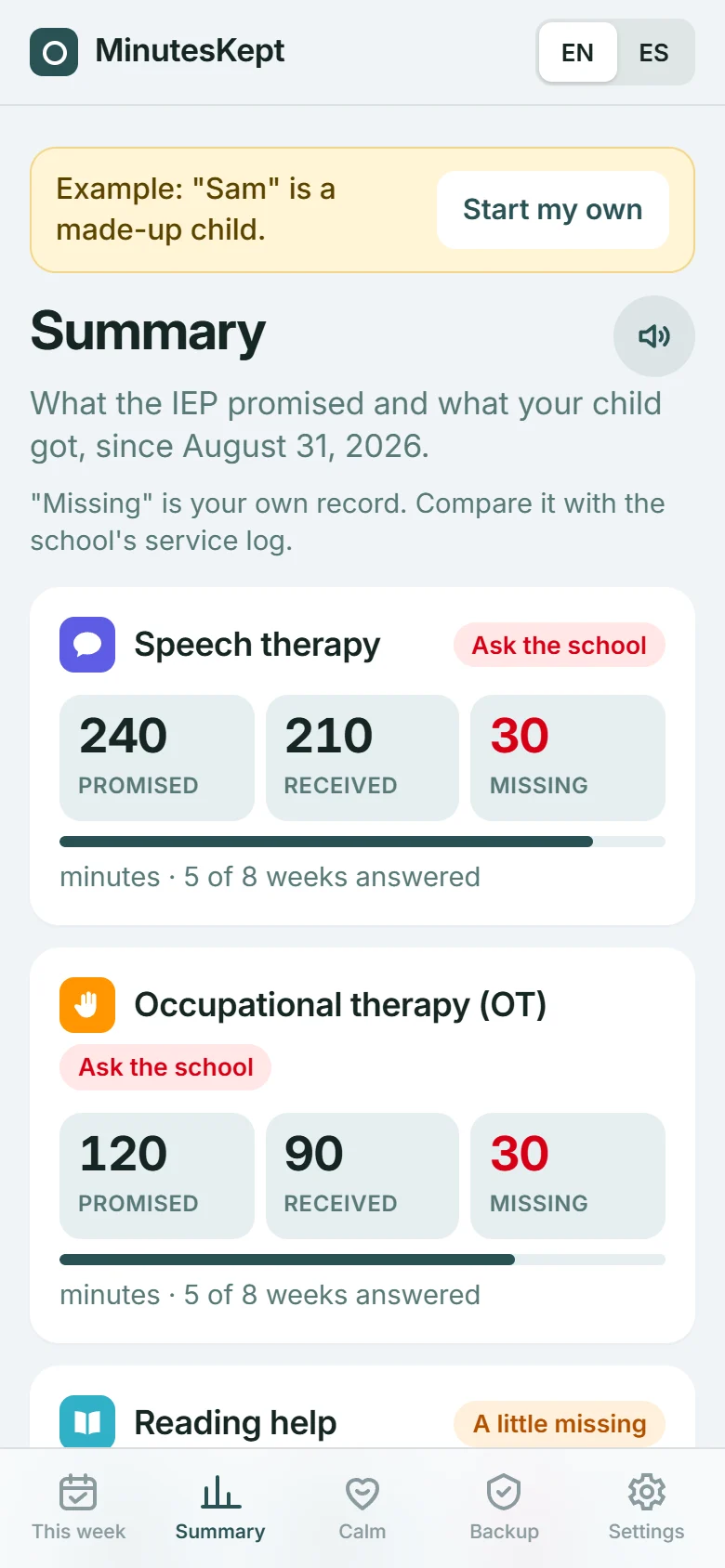
The letter is only as good as the count behind it. MinutesKept is a phone tool that keeps that count for you.
- Once, about 2 minutes: add each service from the IEP, like speech 30 minutes, 2 times a week.
- Every week, about 10 seconds: one question per service. Tap "Yes, all of it", "Only some", "No, not at all" or "No school this week". Pick a reason for a miss, like "Therapist was absent". English or Spanish.
- Automatic: minutes promised, received and missing, week by week, with dates.
- When something's off: a ready email asking the school for its service log, and one page to bring to the meeting.
It never asks for your child's name, and you don't upload the IEP. Your record stays on your phone.
Not an IEP family? The same count and the same kind of letter work for a 504 plan with services, early intervention (IFSP), private therapy or tutoring. If sessions are promised each week or month, you can track them and ask for make-up sessions.
See how it looks before you add anything of your own. Free, no sign-up, opens on any phone.
Try the free example (made-up child "Sam") →
Also worth reading: how to count missed IEP minutes, 5 signs your child is missing IEP minutes, and what to do when the IEP isn't being followed.
Questions parents ask
What is compensatory education in special education?
Extra services a school provides to make up for services it should have delivered. Wisconsin's education department says they are not necessarily provided minute-for-minute. The IEP team decides the amount and type.
What are compensatory services in an IEP?
Compensatory services are make-up services written into or alongside your child's IEP, with a stated duration, frequency and amount, after missed services affected progress. The terms compensatory education and compensatory services are used for the same idea.
How do I ask for compensatory education?
Email or write to the IEP team. Name the service, give the dates and your count of missed sessions, ask for the provider's log, and ask the team to meet and decide the make-up plan. Disability Rights Ohio says a request can go by email or letter.
Is there a deadline to ask for compensatory services?
Federal rules set time limits for formal filing, which is a reason to ask early. Under them a state complaint must allege a violation within one year of receipt, and a due process hearing request generally must come within two years of when you knew about the problem, unless your state sets its own limit. Check your state's rules.
Does the school owe make-up time for every missed session?
Not automatically. Wisconsin's guidance says minor interruptions that get made up are not likely a denial of FAPE, and larger gaps are judged case by case, including the effect on your child's progress.
Can I use this letter if my child has a 504 plan or private therapy?
You can adapt it. Change the names and the service, and ask the provider or school for their session record and a make-up plan. Whether a make-up is owed depends on the plan or contract.
Organize and document. Not legal advice. For free help with your rights, contact your state's Parent Training and Information Center.
Sources, opened November 2, 2026: Disability Rights Ohio, "Understanding Compensatory Education" (June 29, 2021); Wisconsin DPI, "Considerations for Interruptions in IEP Service Delivery"; 34 CFR 300.151; 34 CFR 300.153; 34 CFR 300.511; 34 CFR 300.613.